

Cfm Botswana News
Christianity in Botswana
More than 70% of the population of Botswana is Christian, with most being members of the Anglican, United Congregational Church of Southern Africa, the Methodist Church of Southern Africa, and African independent churches. Anglicans in Botswana are part of the Church of the Province of Central Africa. Membership in the Roman Catholic Church includes about 5% of the nation's population.
Recently[when?] the number of Pentecostal churches has been rising. A strong revival has been going on and most churches conduct all-night prayer meetings. In these meetings the prayer requests include the leadership of the country and all the ministers in the body of Christ. Some of the churches include Pentecostal Protestant Church, Assemblies of God, Apostolic Faith Mission, Eloyi Christian Church, Pentecostal Holiness Church, Dutch Reformed Church in Botswana, Good News Ministries, Christ Embassy, Bible Life Ministries, Victory International Centre (VIC) to name but a few. There's also the presence of Eastern Orthodox Church.
History tells that one of the first missionaries to bring the gospel to the land of Botswana was David Livingstone. The churches normally meet occasionally to worship together under the name Evangelic Fellowship of Botswana.
Christ Embassy Pastor Deported
Two Zimbabwean pastors were deported last Friday after they were declared Prohibited Immigrants by the government.
ByBY MONKAGEDI GAOTLHOBOGWE
STAFF WRITER(GMT +2)
Chris Chissana of Christ Embassy and Edmore Chaka of the Abundant Life Ministries were repatriated together with University of Botswana media studies lecturer Ceasar Zvayi (see separate story on Zvayi). Christ Embassy has been Botswana fastest growing Pentecostal Church. Spotting a maroon suit and s-curl hairstyle, the stylish Chissana looked shocked on Friday as he was being loaded in a police van. His voice was shaking as he said:
"I do not know what is happening. I cannot even explain it myself. What do you do when you are just picked up from your house... it happened so fast, I do not even know what I have done, I had no chance to explain anything," he said just before he boarded the van. Sympathetic members of Chissana's church, who waited for him at the Moonlight Lodge where the state agents had gone to collect Zvayi's belongings, gave him P200 to buy drinks along the way. The Monitor understands that Chissana is married to a Motswana with whom he has children.
Chissana's Christ Embassy Church has become one Gaborone's busiest spot, attracting people from all walks of life. Popular gospel musicians such as Mathews Matsetse, Ernest Seakgosing and to club DJs like DJ Bax have been there. The church attracts a multi-racial crowd, especially Nigerians.
In Gaborone, the Block 8 branch of the church commands a following of over 1,500 people, while the BBS branch has about 600 people. In a less than five years, the church has established more than 15 branches all over the country. Attempts to talk to the church elders in Gaborone after the deportation of their head were unsuccessful on Saturday. First an elder called Mark, said he would grant an interview after 4pm, as the church elders and the pastor's wife, must meet first. "By 4pm, we will have met and discussed the issue, as you know it happened so suddenly, only yesterday (Friday), so people are still in shock. I also don't want to be quoted saying anything about the matter until we have adopted a stand," he said. He never gave an interview and after 4pm, a different pastor called Ade came and promised to grant an interview later. He did not keep the promise despite several attempts to reach him. The Monitor has since established that the multitudes that gathered for Saturday service at the Block 8 branch were not informed about their pastor's deportation. They were encouraged to be strong in faith, according to a devout member who attended the service.
Christ Embassy in Botswana has been on the spotlight for a while. The Director of Civil and National Registration, Mabuse Pule, has in the past made it clear they are investigating the church. He said the church is not registered. Its application to register as a church was turned down in 2005 because it did not meet certain requirements.
Botswana has registered 923 churches since 1973. However the mushrooming of churches, especially by foreign nationals, has been a cause for concern for politicians.
Christ Embassy was started by controversial Nigerian preacher and healer Pastor Chris Oyakhilome. The pastor has been accused by a member of the church in South Africa of staging miracle-healing sessions.
South African newspaper, Sowetan has reported that he has been hiring people to pretend to be sick and disabled. The pretenders are then 'healed' during his television shows and public prayer meetings.
Meanwhile, on the day of the deportation, the thin looking Chaka of the Abundant Life Ministries wore a red shirt. He has been in the news for sometime, especially after he told his followers taking ARV drugs to discontinue and surrender them to him.
Zimbabwe Pastor Deported from Botswana after Urging Church Members to Stop AIDS Medicine
Posted on August 19, 2008 by Richard Bartholomew
From the Botswana Sunday Standard:
Deported Zimbabwean priest, Edmore Chaka, is suspected to have used his church, Abundant Life Ministries, in a racket to rob HIV Batswana of their ARV medication and sell it on Zimbabwe black market.Police started investigating Chaka after a number of his followers who were HIV positive died after he told them to surrender their ARV drugs to him and, instead, use the suspicious concoction that he sold to them. It has not been established where Chaka took the ARV drugs that his followers surrendered. It is, however, suspected that he sold them in the Zimbabwe black-market where they are on high demand…
Chaka was deported alongside Pastor Chris Chissana, who was allegedly running an unregistered branch of the Christ Embassy (a Nigerian church, which I blogged here), and none other than Caesar Zvayi, former editor of the Zimbabwe Herald and notorious pro-Robert Mugabe hack (see here). Zvayi has now written an account of his “ordeal”, in typical form:
…the campaign was directed to the House of Chiefs, of which Ian Khama (Khama IV) is a member, having descended from Khama III, one of the Kgosi (chiefs), who along with two others — Bathoen 1 and Sebele 1 — approached the Queen of England, Queen Victoria, in October 1895, to ask for protection from Boer encroachment as other African countries selflessly fought colonialism in the region.
The trio’s actions saw Botswana become a British protectorate sworn to the politics of Western appeasement, and the trio venerated as Batswana heroes to this day.
Zvayi claims that one of the pastors was in fact deported because “opposition BNF members” attended his church.
Zvayi’s account has some differences from other reports: “Edmore Chaka” has become “Edmore Chijena”, and he, rather than Chissana, is named as running a “Christ Embassy” church.
Botswana deports Kenyan pastor over fraud
By WENE OWINO, NATION Correspondent
GABORONE, Sunday - A Kenyan pastor and his family have been reportedly deported from Botswana for misappropriating church funds and property and dubious business dealings.
The private weekly, Botswana Guardian reports in its current edition that Pastor Chris Barasa attempted to illegally transfer a plot belonging to City Bible Ministries to his name and operating unregistered businesses under the aegis of the church to avoid paying tax.
It is reported that the little known pastor often wrote false reports and submissions which included audited accounts on behalf of the church to the government.
Pastor Barasa of the obscure Gaborone-based City Bible Ministries was reportedly declared a Prohibited Immigrant (PI) early this year but he escaped from Botswana before he could be served with a deportation order.
“Pastor Barasa was long declared a PI but he skipped the country leaving behind his wife and relatives. The law enforcement units never found him to serve him with a deportation order. His wife and relatives and the ones we served recently,” the Botswana deputy spy chief Mr Tefo Kgotlhane reportedly told the Guardian.
The deportation order was served on Pastor Barasa’s wife Pascelisa and close relatives. The Pastor is accused of money laundering, fraud and attempting to grab church land in Gaborone. The land was allegedly bought by members who were asked to contribute a minimum of P6,000 each (approximately Ksh 66,000).
Meanwhile, the chairman of the Kenya association in Botswana Mr William Kaboro said that they are not aware of Pastor Barasa’s deportation nor that of his family.
Mr Kaboro told the Nation that they do not even know Pastor Barasa. “I go through the membership register regularly and I have never seen a name like that (Chris Barasa). No we are not aware of him,” Mr Kaboro said.
Pastor Kingship Ntabotha of City Bible Ministries said he does not know the fate of Pastor Barasa. “We have not heard about it,” he said.
BOTSWANA: Immigration privileges for preachers revoked
Photo: Guy Oliver/IRIN
Illegal immigrants disguise themselves as preachers
GABORONE, 23 October 2009 (IRIN) - Botswana has closed a loophole allowing pastors and preachers to avoid certain immigration regulations.
The special dispensation for men and women of the cloth allowed them to practice or hold church leadership positions, making it easy for foreign nationals to disguise themselves as preachers.
They could apply for a waiver and start work immediately on entry into the country, rather than having to wait while their applications for work permits were approved and processed.
In the last decade as many as three million Zimbabweans are thought to have fled to neighbouring states such as South Africa and Botswana, and further afield to Europe and Australia, to escape the economic meltdown in their country.
Zimbabweans are eligible to stay in neighbouring Botswana for 90 days if they produce a valid passport, but passports are difficult to obtain, while the cost puts them beyond the reach of most citizens.
Lebogang Bok, a spokesperson for Botswana's labour and home affairs ministry, announced on 22 October that "Effective 1 August 2009 ... All new applicants, non-citizens, priests, pastors and church leaders, etc., will be required to obtain work and residence permits before commencement of ministry or preaching in any church in Botswana."
The new regulations mean that hundreds of foreigners, particularly those from Zimbabwe and Nigeria, could be deported to their country of origin. Bok said the authorities would strictly apply the new measures.
"As a result of the removal of the exemption, those whose residence permits have expired, or will be expiring, are required to apply for work permits upon renewal of their residence permits. It is recommended that such applications should be lodged about six months before expiry and or renewal to avoid inconvenience," Bok said.
Church registrations
In 2008, Zimbabwean pastors Chris Chissana of Christ Embassy Church, and Edmore Chaka of the Abundant Life Ministries, were deported from Botswana and declared prohibited immigrants.
Christ Embassy Church has branches across Botswana and is one of the most popular churches in the capital, Gaborone; the branch in the low-density suburb of Block 8 has a membership of close to 2,000 people.
The regulations come on the back of the government scaling up its efforts to register all churches and their members in a bid to rein in foreign nationals overstaying their visas. There are an estimated 1,000 church groupings in Botswana.
Zimbabwean Pastor arrested During Church Service In Botswana
A pastor from Zimbabwe, who was fined P500 or four months in prison in default of payment for entering Botswana illegally, is facing deportation
Shadreck Lovedale 36 was found guity last Tuesday after admitting to have entered Botswana through an ungazetted point at Matsiloje on October 25 2013, by the principal magistrate Sijabuliso Siziba.
The sentence was suspended for one year on condition he does not commit any offence that has an element of dishonesty.
Lovedale is a pastor and founder of Gospel Impact Church in Francistown. He was arrested during a church service on Saturday evening.
He told the court that although he did not have any legal justification for having committed the offence, he was forced to overstay in the country to oversee the growth and progress of his infant church.
“I applied for residence and work permits and was at first rejected by the minister of Labour and Home Affairs,” he said.
“I then reapplied and my days were exhausted while awaiting a reply from the minister.
“I wanted to teach some of my congregants how to run the church in my absence while waiting for the reply from the minister, but unfortunately found myself in this situation.
“I sincerely apologise for my unlawful actions,” Lovedale said.
Sentencing the accused, Siziba said he took into consideration that the accused was a first offender.
However, the magistrate said the accused had committed a serious offence that carries a maximum sentence of four years in jail and a fine of P4 000 or both.
“First offenders should be treated with leniency although the court does not condone their unlawful actions,” Siziba said.
“Also, this court is inundated with cases of foreigners entering Botswana through ungazetted points of entry.
“Nonetheless, your motive in the commission of the offence shall be taken into account.”
Kutlwano Police Station commander Letsholathebe Mothibi said Lovedale had been handed to the Centre for illegal immigrants for deportation.
He said the pastor might be allowed to come back to Botswana to preach after normalising his work and residents permits. – Mmegi
Related articles:
-
Miracle Diamonds ‘Rain In Church Service’
-
Pastor Named in Church Woman’s Death
-
“Pastor Actually Has Sex With Every Young Girl In Church”
-
Zimbabwean man shot in Botswana
-
Pastor jailed for sodomy
Wolves in sheep’s skin
Government would rather tolerate it when citizen pastors misbehave as opposed to foreigners, a government official has said.
In an exclusive interview with The Midweek Sun on Monday, Director of Immigration, Mabuse Pule spoke with burning anger about the findings of government on the mushrooming of foreign churches. “They come here to abuse God, our people and to push their personal agendas,” he said. He uses the Biblical analogy in Matthew 7:15 which likens such people to wolves in sheep’s clothing. According to Pule, Botswana is facing the Biblical end times season, which explains why many pastors from outside are flocking into the country for personal gain. Immigration records on Prohibited Immigrants show that pastors top the list.
This year one pastor was deported. Last year, they recorded three PIs, and Pule states that on average, one or two are pastors every year. Nigerians, followed by Zambians and Zimbabweans are the most deported pastors. He says that foreign pastors who threaten the national security are mostly those who are involved in money laundering and financial epilepsy, rampant drug dealing, womanising in the church, fighting for power and failure to submit annual returns as required by the law. The worst, he says are pastors who often preach ill about president Ian Khama, the Directorate of Intelligence Services and government in general.
“For as long as they will continue to destroy the peace of this country, we will continue to deport them,” he says. He cautions that pastors should not come near church money but rather depend on the church’s finance department for financial feedback. Actually, he informs church members that every church should have an independent auditing firm and annual general meetings should be held for them to be given feedback on how their money is being spent. He reveals that church members often come to report these acts of misconduct to them, upon which they will carry out their own investigations. “The truth is every pastor knows what he or she does in secret, and when we find out their dirt, we send them out of our way,” he says. Pule recalls how at times some foreign pastors come to his office to plead for forgiveness after agreeing with the findings. However, he says that they should know that government would never deport a clean pastor.
Citadel pastor deported
This year May, government declared Ghanaian Pastor Felix Larson of the Christ Citadel International Church of Botswana a prohibited immigrant after his superiors from the church headquarters in Ghana told Botswana government that he was not remitting money to them as required from him as a branch leader but rather using it on himself. Reliable sources say he had been in Botswana for over 12 years. “They told us that he was using it for his personal gain and living a luxurious life,” says Pule. The church has since advertised his position. According to the online advert, the ordained reverend minister must have a minimum qualification of Masters in Divinity and should possess apostolic, deliverance and prophetic calling, with over 25 years experience in church planting.
Responsibilities include, to oversee explore, train, develop, serve and empower Batswana in spiritual matters. In addition, he should be married for more than 20 years with current membership of over 500.
Is government attacking foreign pastors?
A foreign pastor who chose anonymity wags a finger at the government of Botswana for bringing confusion in churches. He says that government should leave them alone to do the work of God because God called them into this country. “Not all of us are bad but again, government should stop intimidating us,” he says. He adds that Batswana pastors are not as charismatic and powerful like them hence citizens migrate to their churches as opposed to citizen run churches. An attendant of his church confirmed this and said before she joined his church, she was struggling to grow spiritually and materially. “Foreign pastors run churches with dynamism, flexibility, vibe, fire and preach prosperity which our Batswana pastors avoid,” she says, adding that citizens do not deliver and do miracles though they are gifts from God. But for Pule, this explains why there is tension between the two pastors. He says that he receives reports from church members complaining that their pastors feel Batswana men of God are mediocre and not up to scratch.
“These pastors even group themselves and see our own pastors as outcasts in their own country,” he says. On the same issue, he states that foreign pastors who feel local media is conniving with government to attack them are offended because they are guilty. He says that media plays a watchdog role.
Are Batswana ignorant?
When Gaborone based church New Seasons church pastor Francis Sakufiwa was deported last year, the church laity was furious to put it mildly. Investigations carried out by this publication showed that he was into women and had left many with severe heartbreaks. Pule blames Batswana for tolerating indecency in the church. He reveals that after the incident, nine women came to his office to ask him to plead for mercy from president Khama.
“They said that he is highly anointed and that we should reverse the decision,” he says, also urging Batswana to be vigilant at all times. Currently, Botswana does not have a deliberate localisation programme on pastors. However, Pule mentions that they will soon introduce it. “God does not bring crooks here and we are not going to allow anyone to deceive our people using his name,” he says. The thought is not new.
Former minister of Labour and Home Affairs Peter Siele and Ntlo ya Dikgosi deputy chairperson Kgosi Lotlamoreng II started the motion in 2010 and 2011 respectively over concerns of issues of expatriate pastors defrauding Batswana.


Pastor and Mrs. Gondwe are the core founders of Crossfield Ministries Botswana. They started the work in 2000 in the house of Pastor Kanyata who at this time is pastoring in Zambia with the wife. The pastor and the wife came in Botswana in 1998. They are both Zambians with three children Towela, Ellase and Jonathan Gondwe.
Since the inception of Gods work they have both worked tirelessly to their call as ministers of the gospel. The church is growing and people are adding up slowly to the work of God. God gave them a vision of 15000 seating capacity church and slowly the vision is being realized. Today they are building the first step church towards the 15000 mega church. The two have honestly answered the call to reaching out as many souls as possible. The new building will accommodate 1500 souls in one roof. To God be the glory.

Pastor Gondwe & the wife


This building is not yet finished. In fact we meet in a half uncomplited building....soon the building will be finished. Our God is so much in control. Our faith is stronger than ever. We have resolved to finish in time.
Haggai 1:6
You have planted much, but have harvested little. You eat, but are never filled. You drink, but are still thirsty. You put on clothes, but are not warm. Those who earn wages end up with holes in their money bags.’”
Haggai 1:9-11
9 ‘You expected a large harvest, but instead there was little, and when you brought it home it disappeared right away. Why?’ asks the LORD who rules over all. ‘Because my temple remains in ruins, thanks to each of you favoring his own house! 10 This is why the sky has held back its dew and the earth its produce. 11 Moreover, I have called for a drought that will affect the fields, the hill country, the grain, new wine, fresh olive oil, and everything that grows from the ground; it also will harm people, animals, and everything they produce.’”
Ezra 5:2
Then Zerubbabel the son of Shealtiel and Jeshua the son of Jozadak began to rebuild the temple of God in Jerusalem. The prophets of God were with them, supporting them.
The Cfm building
The decorating team pause a photo with the praise team. This was after church service. Beautiful picture
1 John 4:21 (NET)
And the commandment we have from him is this: that the one who loves God should love his fellow Christian too.
Loving and smiling





Towela 15, Ellase 12 and Jonathan 9 ....two girls and one boy. Prov 10:22 The blessing of the LORD makes rich, and he adds no sorrow with it.
Psalms 127:3 (NET)
Yes, sons are a gift from the LORD,
the fruit of the womb is a reward.
Pastors Children
Ellase Gondwe
Jonathan Gondwe
Towela Gondwe
Cfm the Apostolic Christianity
The text names four elements as expressive of the variety in unity of primitive Christian life. They continued steadfastly—
I. In the Apostles’ Teaching.
II. In the Fellowship.
In the Breaking of Bread.
In the Prayers.
The great Christian thinker and preacher of Protestant Lausanne, as he compared the splendour and enthusiasm of the Roman Benediction with the shorn and meagre rite of Genevan Calvinism, exclaimed in melancholy tones, “Rome has worship without the word, we have the word without worship.” But the earliest Church, as delineated by its great historian, combines all these elements, and appeals to man through all his faculties. It appeals to his intellect by its doctrine. It awakens his social feelings—whether towards contemporary Christians, or spirits waiting in the world unseen, or great predecessors in the faith; nay, something higher still—“And truly our fellowship is with the Father, and with his son Jesus Christ.” It deals with the soul in its most mysterious depths by the consciousness of a Presence at once awful and blessed. It has treasures, and it opens for every one of its children a language of sobs and rapture, of penitence and joy—a wealth of words that set themselves to some far-off music, which linger along fretted roofs, yet nestle in our hearts, and in our last hours sing us into the sleep of death as if with the lullaby of God. Thus, as in the description of her first structure, the Church is doctrinal, social, sacramental, liturgical. She is a school of teaching, a centre of social unity, a shrine of sacraments, a home of worship. The child of heaven, destined to an inheritance so splendid, was strong and radiant in her cradle. All the possibilities of her history and her being lay folded in her heart from the very first.
The Teaching of the Apostles
1. “The teaching of the Apostles” was the necessary instrumentality for bringing the new converts to full discipleship. Their rudimentary faith needed a careful and continuous instruction, an instruction which replaced that which the scribes were in the habit of giving, so that in the most literal sense the Apostles might now be called scribes become disciples to the kingdom, bringing out of their treasure things new and old, the new tale of the ministry and glory of Jesus, the old promises and signs by which Law and Prophets had pointed onward to Him and His kingdom.
2. But, further, the teaching of the Apostles had a far wider range when their disciples were not converted Jews, but converted heathen. Then they had to create a new morality, to lay firmly that foundation which the Jews had received from their long tradition of legal righteousness, to adapt the principles to the novel conditions of Gentile life.
3. Can we tell what the teaching of the Apostles chiefly consisted of?
(1) Even a superficial study of St. Paul’s Epistles enables us to understand the magnitude of the task which rested on the Apostles as religious teachers. Take, for sufficient example, the First Epistle to the Corinthians. We find clearly indicated there a teaching extraordinary in depth, range, and variety. St. Paul brings to the Corinthians the knowledge of Christ’s life and death, and the substance of His revelation. He interprets the Old Testament in the light of Christian belief; he develops a detailed doctrine of the person and work of our Saviour. Consider how large a background of theological knowledge, built up in the Corinthians by systematic teaching, is implied in such a verse as this: “But of him (i.e. God) are ye in Christ Jesus, who was made unto us wisdom from God, and righteousness, and sanctification, and redemption.” Is it not suggestive that we should find the great keywords of the Pauline theology in the least theological of his Epistles? In this same Epistle to the Corinthians we find a very definite and rich teaching about the Holy Spirit, an eschatological doctrine of great range and richness, the most careful moral teaching, and the delivery of practical rules, customs of the Christian society, which the Apostle does not hesitate to impose on the Corinthians. No doubt St. Paul stood out from the apostolic company as a great constructive theologian, and we cannot suppose that the other Apostles, with the exception of St. John, were able to bring to their converts so rich and varied a volume of sacred science; but then we must remember that St. Paul, to use his own phrase, “laboured more abundantly than they all,” and that, even in the apostolic age, his Epistles were widely disseminated. In the New Testament, then, alone we have abundant evidence of the active vitality of the teaching of the Apostles.
(2) But we can also bring evidence outside the New Testament. Two documents have come down to our own time with the claim to embody “the teaching of the Apostles,” and though neither can vindicate an apostolic origin, yet both do certainly perpetuate aspects of the work of the Apostles as the teachers of the Christian society. The oldest of these documents is a curious moral treatise dating probably from the first half of the second Century, though it may be much older, and actually entitled The Teaching of the Twelve Apostles. It illustrates the work which, especially among the Gentile converts, fell on the Apostles as creators of a Christian morality, which should replace the depraved and perverted traditions of heathen life. The other document, later in actual composition, is not less apostolic in character. It is known throughout the world as “the Apostles’ Creed.” Of course we must be watchful against the anachronism which would credit the Apostles with precise dogmatic forms, such as were afterwards received in the Church on the authority of their names. But though the so-called Apostles’ Creed did not exist in apostolic times, we must admit that the substance of its teaching was primitive. The Ignatian Epistles, which are the connecting link between the Pastoral Epistles and the Apologists of the second century, prove that instruction was given in Antioch on all the points characteristic of the teaching of the developed creed.
(3) But by the “teaching of the Apostles,” in which the first Christians continued, we are not to understand a detailed moral code, or an elaborated creed, but rather a progressive instruction, which included both morals and doctrine, which addressed itself with rare versatility to the novel and ever-varying requirements of a quickly expanding society; and always laid the emphasis on the things which were fundamental.
I like the advice which Mr. Birrell gave at Whitefield’s Institute: “Do not worry too much over the many things you are in doubt about; hang on with all your weight to the things, however few, about which you are certain, and on the top of these certainties pile up work, work, work!” May I take a little liberty with one of the great sayings of Shakespeare, a liberty which does no fundamental violence to the text, “The truths thou hast, and their adoption tried, grapple them to thy heart with hoops of steel
4. Thus from the beginning, the Church has possessed and depended upon a “teaching ministry”; and, though in later times the reason of that dependence may seem less evident, and though, for obvious reasons, the functions of the ministry have taken a less exalted character, yet, when we consider that every generation comes fresh to its problems, and that the unalterable principles of the Gospel have to find application to circumstances which are always novel, we shall be little disposed to question the title which the teaching ministry can still advance to the regard and consideration of believers. It is still the case of loyal and prudent Christians that “they continue steadfastly in the apostles’ teaching,” when they impose on themselves as a standing obligation of a well-ordered Christian life, the regular and devout attendance on the work of the Christian preacher.
The Fellowship
The word translated “fellowship” comes from a root which means literally sharing in common. The practical nature of the fellowship is very clearly seen by comparing the ways in which the same word is translated in other places in the New Testament. As a rule Scripture is its own best interpreter. In Rom 15:26 the same word here translated “fellowship” is rendered “contribution”—“It hath pleased them of Macedonia and Achaia to make a certain contribution for the poor saints which are at Jerusalem.” In 2Co 9:13 it is “distribution”—“Your liberal distribution unto them, and unto all men.” In Heb 13:16 it is “communicate”—“To do good and to communicate forget not: for with such sacrifices God is well pleased.” In 1Co 10:16 it is “communion”—“The cup of blessing which we bless, is it not the communion of the blood of Christ.” While in Php 1:5; Php 2:1; Php 3:10 it is plainly used in the sense of “participation.” From all these Scriptures, the meaning of the word is clearly defined. It was the word used for the collection of money for the poor saints, and for the share which believers took in transmitting these alms to those in need. Fellowship in this sense is a most exalted and noble thing, and a privilege not to be lightly esteemed. It showed the oneness of the whole body of the faithful in state, in privilege, and in Obligation. Sharing thus in common there was created a spirit of mutual recognition, a manifestation of common interests, and a closer partnership with each other in the blessings and privileges of the Gospel—leading them to share joyfully their goods with others. Taking the word in the meaning thus given, we cannot fail to see that the contribution or collection became a regular, an abiding institution in the Church of Christ.
And they continued steadfastly in the apostles’ teaching and fellowship, in the breaking of bread and the prayers.—Act 2:42.
1. In these words are set forth the characteristic marks of the new Christian life to which the converts of Pentecost were pledged by their Baptism. The Apostles stand out as the core of the Church. About them the new disciples are gathered; from them the doctrine and discipline of the infant society proceed; they constitute a visible centre of unity.
2. The Church was not only holy, catholic, and apostolic, but it was also one. The world recognized that unity, and felt its power. A bishop of the Church in Ephesus was a bishop of the Church in Lyons, and a member of the Church in Alexandria was a member of the Church in Arles. The Church newly planted in Armenia was immediately brought into relation with the Church wherever it was already existing. There was a principle as real in the Church which was producing this unity, as the principle of gravity in the solar system which is binding it into unity and harmony. It is not difficult to discover that principle. If we turn to the inspired history of the Church, we shall find that principle of unity clearly stated. “They continued steadfastly in the Apostles’ teaching and fellowship, in the breaking of bread and the prayers.” Here are four things—the teaching, the fellowship, the sacrament, and the worship.
We greet one another cordially as brethren, and we meet in committees and on platforms and in various other ways. Some of us have become members of the Evangelical Alliance, and we have various ways of expressing the unity that remains to us across the divided lines of our Churches. Ah, but there was a time, gone by long, long ago, when all those who in any place confessed a common Lord exercised their unity around the same communion table, and in the courts which Christ had set up, and not in such committees and alliances as we have been compelled to plan because we had fallen from the others. There was a time when it entered into no Christian mind that, in any place, those who confessed our common Lord were to sit down contented with a unity that was not expressed and could not be in Christ’s ordinances and Christ’s institutions. There was a time when, if anything fell out to break it, men were grieved and humbled and Apostles wrote moving letters to the Churches concerned; and after the Apostles were gone, the Church of Rome sent her letter to the Church of Corinth to entreat them to be visibly one in the institutions and ordinances which Christ gave them to express and to exercise their unity. There was such a time, and if since post-apostolic times the Church has gained something—and I think it has gained much—yet surely it has lost something too. There was something they had in the early Church, when they met around the same communion table and in the same institutions just as naturally as they went to one martyr-death together—there was something then which we have not now.
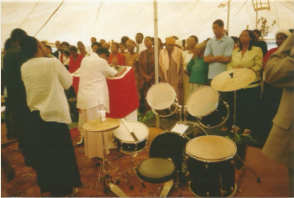
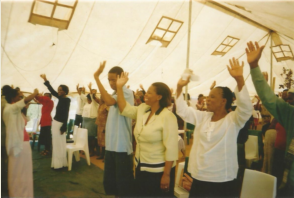
The early times of the church when meeting in the tent. God wanted us to build Him a house which we are now building...praise the lord.
There are two notions of unity in men’s minds. One of them is really the notion of uniformity. It has no place for diversity. It wants almost complete identity between the things which it compares. The other rejoices in diversity, and finds its unifying principle in the common motive or purpose out of which an infinite diversity of many actions may proceed. How vain the search for any unity but this! It is the unity of nature. The budding, bursting spring is full of it; a thousand trees all different from one another are all one in the oneness of the great life-power which throbs and pulsates in them all. And souls the most unlike, most widely separated from each other, are one in Christ. Christ is their principle of unity. The thinker pondering deep problems, the workman struggling with the obstinacy of material, the worshipper lost in his adoration, the men of all centuries, the men of all lands,—they are all one, if all their lives are utterances of the same Christ. It is beautiful, the way in which each new Christian strikes into this unity and becomes a part of it immediately. A man has been living by himself, seeming to find all his sources of activity in his own life. By and by the change comes and he is Christ’s. The pulse of universal Christian life begins to beat through him. Now he is one with all men who, anywhere, are doing anything by Christ for Christ! How he lays hold of and comprehends the ages!
1. There are thus three aspects in which to regard the Fellowship—
(1) It is evident that they encouraged each other in the things of God and continued to do so. They were as one loving family, and loving each other they took every means in their power to keep the glow of love aflame. “As iron sharpeneth iron, so a man sharpeneth the countenance of his friend.” What better means of encouraging the members of the Church can there be than by conversing freely together of the things of God? As the fellowship meant participation, communion; so in their intercourse with each other there was a constant interchange of thought in matters of spiritual experience.
I fear this aspect of fellowship has been sadly lost in these days. How seldom we talk about God! We talk about anything—everything else—about leaders, teachers, sermons, books; but how seldom do we find the conversation, even among a party of Christians, centring round God; and yet one of the sweetest of the “precious and exceeding great promises” is given to those who practise the habit of speaking about God, and the things of God. In the same chapter in which we read of bringing “all the tithes into the storehouse,” and so paying attention to the contribution, the collection, and proving the Lord of Hosts herewith, we also read these precious words: “Then they that feared the Lord spake one with another; and the Lord hearkened, and heard, and a book of remembrance was written before Him, for them that feared the Lord, and that thought upon His name. And they shall be mine, saith the Lord of Hosts, in the day that I do make, even a peculiar treasure, and I will spare them, as a man spareth his own son that serveth him. Then shall ye return, and discern between the righteous and the wicked, between him that serveth God and him that serveth him not” (Mal 3:16-18).1
(2) They had a mutual regard for each other’s welfare, and continued to show it. Communion, participation, fellowship cannot exist where one member is indifferent in the smallest degree to anything that affects the interest of another. The member who takes no interest in the welfare of his fellow-members is guilty of violating the partnership in which all believers are embraced. If I am one with him, what touches him, touches me; his sorrows, dangers, duties, joys, prosperity, or adversity are mine. In true fellowship there can be no isolation, no independence: all are sharers in common. If we are members of the body of Christ, then, in a very real sense, “there should be no schism in the body; but the members should have the same care one for another. And whether one member suffereth, all the members suffer with it; or one member is honoured, all the members rejoice with it” (1Co 12:25-26).
(3) There was also regular, systematic provision made for practical help as it was required. Continuing in the Apostles’ fellowship, it is clear that the members of the Church gave freely and willingly “as the Lord had prospered them” for the relief of poor saints, and that a regular distribution of the contributions so given was made to those in need. Later on, “when the number of the disciples was multiplied,” it was found absolutely necessary to appoint deacons to take this matter in charge, that they, overlooking the temporal affairs, might leave the Apostles free to attend to the purely spiritual matters. That these contributions became a regular institution, a weekly ordinance, in the Churches of Christ, is clear from Paul’s words to the “Church of God at Corinth.” Following immediately upon the greatest, the profoundest treatise ever written upon the fundamental doctrine of the “resurrection,” the Apostle, without pause or break, says, “Now concerning the collection for the saints, as I have given order to the Churches of Galatia, even so do ye. Upon the first day of the week let every one of you lay by him in store, as God hath prospered him, that there be no gatherings when I come” (1Co 16:1-2).
2. St. Luke, according to the translation adopted in our versions, links together “teaching and fellowship”; but he certainly does not mean that the early Christians were taught to combine as they did. They entered into an intelligent unity sustained by intelligent communication; but their intercourse was the spontaneous outflow of the new life which, as believers in Christ, they had received. It was a Divine instinct, a soul of brotherhood, a disposition which breathed the atmosphere of “the household of faith.” Good nature could find no sphere large enough for its expression. It was the observance of the second commandment in the most Christlike form the world had ever seen. It was the attainment of the mind of Christ in a measure which overflowed all human relationships. From the first we get an impression of wonderful unity and brotherliness as marking the Messianic Community. With what moving power would the Master’s words be rehearsed by men in whose imaginations the Speaker’s looks and tones, as He had spoken them, still lived and gave each saying life! In the atmosphere of soul thus created self-contained isolation was simply impossible to believers. The impulse to “fellowship” of the most intimate and complete character mastered every other feeling. And in that fellowship they found their strength and stability.
One of the most remarkable methods of preventing the encroachments of the sea upon the land, and fixing the loose sand along the shore, is by means of plants specially adapted for the purpose. These plants belong mostly to the grass tribe, though some are furnished with the flowers and foliage of higher orders. But they all possess in common the peculiarity of creeping underground stems, which at short intervals send up fresh shoots above the surface, and root themselves in the soil. These creeping underground stems enable them to subsist in the barren sand, and endure long periods of drought and sterility; while the rooting of the stems at frequent intervals, producing new individuals at every joint, all linked together, enables them to offer an effectual resistance to the storm. If undisturbed, these wonderfully constructed plants would speedily cover the largest tract of sea-shore spontaneously, prevent the loose masses of sand thrown up by the waves from drifting, and render the soil sufficiently stable to support higher vegetation. Man has taken advantage of the peculiar habit of these seaside plants, and planted them along the banks which he erects as a barrier against the sea, and which without these would be blown away by the first hurricane. The enormous dykes which the people have constructed in Holland, to keep out the inundations of the German Ocean, owe their stability to these plants, which are carefully protected by the Government; and along the low eastern side of England, where the sea is seeking continually to encroach upon the shore, and is with great difficulty kept back, a large quantity of dry land has in this way been reclaimed from the waters. It is the social habit of these seaside plants that gives them their wonderful tenacity of life, and admirably adapts them for the conditions in which they grow. Each separate plant is weak and fragile; and if left to itself it would speedily perish in its sterile situation, and would be uprooted and swept away by the fury of the tide. But when linked and interlaced in the closest fashion, by a vital bond, with the whole mass of similar plants growing around, it can hold its own against the strongest forces of the ocean. It is as nearly indestructible from natural causes as anything can be; and it is one of the most striking proofs of the power of feeble things that are endowed with life, to resist, when in combination, the mightiest forces of mechanical nature.
The Breaking of Bread
We pass on now to the breaking of bread. There can be no question that here we have “the Holy Communion in its primitive form as an Agape or supper of communion,” or rather as a commemoration associated with an Agape or supper of communion. For it is manifest that, in considering the language of St. Luke, we cannot separate it from that of his great master, St. Paul. We are compelled to seek in the First Epistle to the Corinthians the meaning of this simple expression, characteristic of the Acts, “the breaking of bread.” Now, in the tenth and eleventh chapters of that Epistle, St. Paul evidently describes the Agape as preceding the Eucharist. The latter he clearly asserts to be an institution of Christ, and to bear a character of the utmost gravity. He rehearses the history of that Institution, and bases on it some stern and awful censures of the profaneness which marked the Corinthian practice. The “breaking of the bread” was something more than the formal act by which a social festivity was inaugurated. It was more than an eloquent symbol—more than a solemn act of commemoration. It was the current phrase for a religious rite to which the Apostle evidently attributed the greatest importance. The very phrase had historic reference; it was an appeal to the devout recollection of Christians—it recalled and set before them the Master Himself in “the night in which he was betrayed.” The bread which then He blessed and brake was identified with the bread there placed on the table of the Eucharist, and the cup was the same. So the Apostle links together the profanities of the Corinthian Eucharist and that last supper in the room at Jerusalem, where Christ Himself had instituted the sacrament. “For as often as ye eat this bread and drink the cup ye proclaim the Lord’s death till he come. Wherefore whosoever shall eat the bread or drink the cup of the Lord unworthily, shall be guilty of the body and the blood of the Lord. But let a man prove himself, and so let him eat of the bread, and drink of the cup. For he that eateth and drinketh, eateth and drinketh judgment unto himself, if he discern not the body.”
How much lies behind that simple phrase “the breaking of bread!” However close the association of the Eucharist with the Agape was in the apostolic age, it never went so far as to submerge the distinctive character of the Sacrament. St. Paul’s Epistle to the Corinthians, not to say, also, the Gospel of St. John, which certainly reflects the eucharistic doctrine of the later apostolic age, absolutely prohibits the popular notion that the unique and awful significance of the Holy Communion belongs to the later period of the Church.
It is not uninteresting to compare with St. Paul’s language the eucharistic prayer preserved in The Teaching of the Twelve Apostles. “As this broken bread was scattered upon the mountains and gathered together became one, so let Thy Church be gathered together from the ends of the earth into Thy kingdom, for Thine is the glory and the power through Jesus Christ for ever”
1. Now we have seen that St. Paul was very careful to dwell on the deep significance of the Holy Communion, and circumstances proved at this time how necessary this was. But the great precaution which was taken to guard the sacred observance of the Holy Communion does not preclude the joyful association which essentially attached to the “breaking of bread.” The “Eucharist,” the name given to that service, in itself indicates the manner in which the primitive Christians regarded it. “And this food is called among us Eucharistia, of which no one is allowed to partake but the man who believes that the things which we teach are true, and who has been washed with the washing that is for the remission of sins, and unto regeneration, and who is so living as Christ has enjoined. For not as common bread and common drink do we receive these; but in like manner as Jesus Christ our Saviour, having been made flesh by the Word of God, had both flesh and blood for our salvation, so likewise have we been taught that the food which is blessed by the prayer of His word, and from which our blood and flesh by transmutation are nourished, is the flesh and blood of that Jesus who was made flesh.”
In “The Breaking of Bread” the Apostolic Christians possessed one abiding and unchanging secret in which their whole spiritual being stood rooted, in possession of which they could face all that was before them, whatever the long and cruel years might bring. Here that secret was embodied. The innermost soul of this integral life was an act of organic worship, “the breaking of bread.” Christ has passed out of sight, they see Him no more, and they now therefore have sorrow. Sorrow there must be. Nevermore would they have His visible presence in their midst, His voice in their ears, His breath on their brows. Nevermore would they move and walk and talk together, and sit at the same table, and eat in the same room. Nevermore the intimate and enthralling joy of that brief earthly companionship. “And ye now, therefore, have sorrow, but I will not leave you comfortless; I will come unto you, and your joy shall be full, and that joy no man can ever take from you.” So He had promised, and the pledge of that promise being fulfilled came out of the heart of those days now gone, when they had eaten and drunk with Him as His friends that last meal in which the sweet earthly companionship had crowned its blessed intimacy, that last meal in which the old days of friendship had come to a close, and had said their last farewell—so that it seemed to them that a meal of wasted hope and broken hearts was indeed never to pass away. Protected from the fickleness and frailties of change, it was itself to become the undying form of that new companionship with the risen Master, by which and in which, through the working of the Spirit, He, with the Father to whom He had gone, would for ever come again to them and sit down with them, and eat and drink with them, and make His ever-living abode with them, drinking with them the new blood of the grape, as it is drunk in the kingdom of God.
2. Observe the witness which the Sacrament bears to the truths of Christian belief.
(1) And first of all the wonder that such a thing as this, a little bread and wine given as a keepsake by a Jewish man about to die the next day, should have become what the Christian Sacrament has been in the world for two thousand years, should have been found such as it has certainly been found by men—a treasure of truth to great thinkers; of sweet grace to saints and heroes; of simple blessing to homely and plain people; of deep mystery to philosophers and poets; that it should have gone with equal power through times so extraordinarily different, and among men of so many races and lands; nay, should have borne this witness of itself to men, who were engaged sometimes in keenest unhappy controversy about some part of its nature and meaning.
(2) Then what are we to say of Him who, on the edge of death, calmly appointed this thing? Nothing gives stronger witness to the Divine Power, hidden in the Death of Christ, than this, that these words and acts of a dying man became at once the best offering to God, all other sacrifice being put away. And the observance of it, not as a sad memorial of a departed saint, or prophet, or teacher, but as the glad remembrance of a living Lord, is the best of witnesses to the truth of the Resurrection. It was a great Protestant theologian in Germany who spoke of it as the “climax of the early Christian worship,” and found “in its continuing celebration the first proof of the constant belief of Christians in the Divine nature of Christ.” Could any mere memorial of the dead have kept its place, and shown the power of the Eucharist all down the centuries till now?
The Prayers
Finally, there is mention made of “the prayers.” These, in Dr. Hort’s opinion, are probably Christian prayers at stated hours, answering to Jewish prayers. If we knew more of the synagogue services in Palestine as they were before the fall of Jerusalem, we should perhaps find that these Christian prayers replaced synagogue prayers (which, it must be remembered, are not recognized in the law), as the Apostles’ teaching may be supposed to have replaced that of the scribes.2 [Note: Judaistic Christianity, 44.] We know that the Christians in Jerusalem, so long as the temple existed, were accustomed to attend its regular services, and it may well be the case that they also developed a synagogue service of their own. St. James, who presided over that Church, speaks of the Christian “synagogue.” It is certain that the synagogue provided the model after which the liturgical services of the Church were originally fashioned—although from the first there were new elements, such as the reading of the apostolic epistles, the exercise of spiritual gifts, the use of the Lord’s Prayer, and, possibly also, Christian hymns, which gave a distinctive aspect to the worship of the Christian synagogue.
Now let us notice two points in connexion with “the prayers” of which we may well make practical application—the place of prayer in public worship, and the value of united prayer.
1. The Place of Prayer in Public Worship. Those who were converted by St. Peter’s address remained steadfast in prayer: by which it is intended, not merely that they prayed privately by themselves, for this probably they did before, but that they were regular in attending the prayers of the Christian Church. The Church, though in its infancy, had yet its public Services, and those who joined the Apostles’ fellowship joined them in their united worship before the throne of God’s grace. And this, it should be observed, is the proper fruit of a sermon; the sermon is rightly appreciated, is manifestly blessed by the Holy Spirit, when it leads persons to value and join heartily in the Church’s prayers: the prayers are not the mere introduction to preaching, but preaching is intended to make people pray. This is the right order of things, and this is what we find in the history of the great Pentecostal Day. Whether or not this is so in these days is a question to be determined by experience; but this is certain, if any preaching is followed after merely for its own sake, and if the effect is not found to be greater earnestness and devotion in the prayers, then it may be the fault of the preacher, or it may be the fault of the people, but there is a fault somewhere, the preacher has missed his aim, his arrows have flown wide of the mark. The same Holy Spirit who came down upon the Church upon the Day of Pentecost, and made the preaching of St. Peter effectual to the conversion of three thousand souls, is with the Church still; and if it is found that in these days many people listen to sermons and yet do not show forth in their lives such clear, practical, almost unmistakable marks of the preaching having touched their hearts, then there is a fault somewhere. It cannot be with God’s Holy Spirit; therefore it must needs lie between minister and people.
It is said about us Free Churchmen that we think a great deal too much of preaching and a great deal too little of the prayers of the congregation. That is a stock criticism. I am bound to say that there is a grain of truth in it, and that there is not, with too many of our congregations, as lofty a conception of the power and blessedness of the united prayers of the congregation as there ought to be, or else you would not hear about “introductory Services.” Introductory to what? Do we speak to God merely by way of preface to one of us talking to his brethren? Is that the proper order? “They continued steadfastly in the Apostles’ teaching” no doubt; but also “steadfastly in prayer.”
2. The Value of United Prayer. Can there be any one who has never felt how the sympathy of others multiplies joy and mitigates sorrow? and in the domain of religion this is doubly and trebly true. Prayer and meditation upon God come so reluctantly from my heart when I pray and meditate alone, but seem as if they were winged when hundreds begin to pray and sing along with me, and seal the same confession with one general Amen.
I often think of the negro woman who was once asked by the governor of Surinam why she and her fellows always prayed together. Could they not do it each one for himself? He happened to be standing at the time before a coal-fire, and the woman answered: “Dear sir, separate these coals from each other, and the fire will go out; but see how brisk the flame when they burn together.” From the mere circumstance that when in fellowship with others our hearts grow warm, we can easily understand what the Saviour means when He says, “Where two or three are gathered together in my name, there am I in the midst of them.” And again, “If two of you shall agree on earth as touching anything that they shall ask, it shall be done for them of my Father which is in heaven.” This, says a devout man, is as when the whole children of a family take heart, and with one accord beseech the father for a boon. It is then far harder for him to refuse.2 [Note: A Tholuck.]
Prayer is much weaker than its real self if many do not join in it.
They Continued Steadfastly
1. Sudden conversions are not always lasting. Many causes besides enlightened conviction may bring about a change of view; and not the least powerful of those other causes is moral contagion. When a mass of men is moved deeply by impassioned eloquence, it is difficult even for a man of calm self-possession to retain the mastery of his emotions, and keep himself free from the influence of that strong sympathetic feeling which, like an electric current, runs through a crowd, and moves many souls, as the mighty rushing wind heaves and tosses the waves of the deep. And what is too often the sequel? Why, the utter absence of steadfastness in the doctrine of Christ. When the cause ceases, the effect disappears. The sympathy dies out for want of fresh Stimulus. Then all is dead. Like a house without a foundation, the assumed Christian profession may be swept away into utter and irretrievable ruin by the first tempest that beats upon it. It is like a human body whose spinal column has been materially damaged; artificial props and stays are necessary to shore it up and prevent its collapse. One test then of sincere adhesion to Christ is steadfast adherence to His doctrine or His teaching—a walk and conversation in accordance with His mind and His precepts.
I have sometimes heard of converts and workers at exciting revivals, who afterwards became limp and languid. When the missioner had departed, they felt like a wedding party when the bride and bridegroom have gone. When the huge choir was disbanded, the little chapel choir appeared so tame and commonplace, and worship indeed had come to its dregs! But here in the apostolic times the exciting day was over, the wonder had somewhat passed, but there was no perilous relapse. They continued in the same road, stepping out determinedly, continuing steadfast in the way of life.
2. Steadfastness implies in particular two points. It implies definiteness and it implies diligence. It suggests either a definite standpoint and diligence to maintain it, or a definite aim and diligence to achieve it. Examples are plentiful to illustrate our meaning. The sentinel at Pompeii who remained firm at his post until the stream of lava engulfed him in its fiery embrace—he was steadfast. The soldiers on the ship Birkenhead who stood in their serried ranks on deck while the women and children got safely off in the boats, and who went down in unbroken order into their vast and wandering grave—they were steadfast. They had a definite standpoint, and they were diligent to maintain it. Nor are instances wanting of definiteness of aim and diligence to achieve it.
Perhaps one of the most striking is presented to us in the history of the famous Warren Hastings. Hastings, when but a boy, conceived a passionate longing to regain for his family the ancient home of his forefathers, Daylesford, which, owing to monetary losses, had passed into the hands of strangers. He was but a poor lad when first the desire seized his mind; but all through his long and chequered career this desire never left him, until towards the end of his life he accomplished his object, and purchased the ancestral home, where he ultimately died.


